
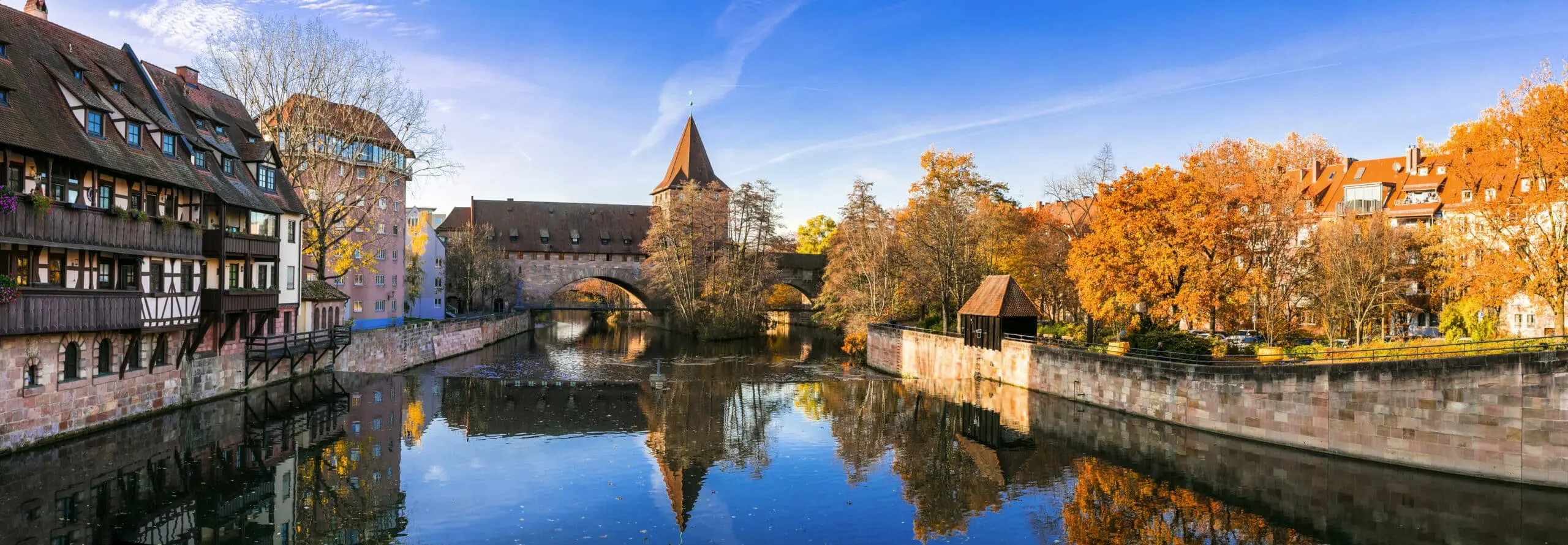
Natural hazards in Middle Franconia
By Christoffer Davis · 19. Mai 2026 · 9 min read
The damage patterns in Middle Franconia have changed in the last three years. Heavy rain events, which statistically should occur every 30 years, now occur twice within 18 months in individual districts of the Nuremberg metropolitan region. Hail damage in May and June is becoming more frequent, while floods on the Pegnitz and Rednitz rivers are reaching frequencies that were still listed as exceptions in the insurance tables of the 2010s. For owners, this means a tough question that is often only noticed late: does my policy even cover these risks?
Anyone who has taken out homeowners insurance in Nuremberg, Fürth, Erlangen or Schwabach will in most cases have fire, mains water, storm and hail included. However, the explicit addition of natural hazards - heavy rain, backwater, earthquake, landslide, flood - is not included in many existing policies. This gap becomes apparent in the event of a claim. A free check via the Davis cooperation with our network partner LZK Versicherungsmakler GmbH reliably shows which risks your current policy covers - and which you would bear out of your own pocket today.
In brief: Standard homeowners’ insurance covers fire, mains water, storm and hail. Natural hazards such as heavy rain, flooding and landslides are only covered by an explicit extension. In Middle Franconia, the claims rate for natural hazards has been rising noticeably since 2022 - a policy review is no longer overly cautious.
What distinguishes natural hazards from standard risk
In its basic form, homeowners insurance protects you against four types of risk: fire and lightning, mains water, storm from wind force 8 and hail. These standard clauses are included in practically every policy and are regularly used in Middle Franconia. What they do not cover is a second category of damage, which insurance law summarizes under the term natural hazards.
Natural hazards include flooding caused by heavy rainfall, backwater from sewers, flooding caused by nearby bodies of water, snow pressure, landslides, subsidence, earthquakes and volcanic activity. In Middle Franconia, the first four risks are particularly relevant. Earthquakes do not play a statistical role, and volcanic activity certainly does not. But heavy rainfall, backwater and flooding have shown several times in recent years that Middle Franconia is not a protected zone.
The key difference to the standard policy: natural hazards are only insured if the extension is expressly agreed. A policy without this clause will not pay a cent, even if the damage was clearly caused by natural events. In practice, this means that anyone who calls their insurance company after heavy rain damage and does not have a natural hazard clause will receive the simple answer that this damage is not covered.
Middle Franconia at a glance: Where the risks have become real
The city of Nuremberg is topographically mixed. The inner city districts along the Pegnitz - Wöhrd, parts of Maxfeld, the old town itself - have historically been affected by flooding. The slopes in the north-eastern parts of the city, such as Erlenstegen or Mögeldorf, experience flash floods and slope washouts during heavy rainfall. In the southern districts along the railroad lines, rainwater collects in depressions and leads to backwater in the cellars. Eibach and Reichelsdorf have experienced such events several times in recent years.
Fürth is prone to flooding in two places due to the Rednitz and Pegnitz rivers. The southern part of the city around the Rednitz-Auenpark showed clear signs of heavy rain in the 2024 and 2025 damage reports. Erlangen experiences snow pressure on flat roofs and occasional heavy rain events in the valley areas along the Schwabach. Schwabach itself and the district of Roth have the most damage reports with storm and hail, followed by heavy rain damage in depressions and below slopes.
For the policy assessment in Middle Franconia, this means that the risk zones are not evenly distributed and they are not static. Insurers work with the so-called ZÜRS system - a geocoded classification model that assigns each building to one of four risk classes. A building in class 1 or 2 is statistically at low risk of flooding, a class 3 indicates increased risk and class 4 marks the highest risk. Market validation by an independent insurance broker shows which class your specific building falls into - and which policy extensions follow from this.
What the natural hazard extension actually covers
Homeowners insurance with a natural hazard clause typically covers direct damage to the building caused by an insured natural event. This includes restoration of the structural substance, drying after water damage, repair of damaged installations and, in better policies, also the additional costs due to official requirements, for example if new requirements for floor sealing apply after flood restoration.
The sum insured is based on the reinstatement value of your building. It is important that the policy matches the current building. A policy that was taken out ten years ago on the basis of the value at that time often only covers a fraction of the actual restoration costs today, after building index increases and possible modernizations. This phenomenon is called underinsurance and leads to a proportional reduction in benefits in the event of a claim - not to a complete refusal, but to a noticeable gap.
In practice, we see two common constellations. Firstly, older policies without a natural hazard clause, whose owners live under the assumption that everything is covered. Secondly, newer policies with a natural hazards clause, but the sum insured is set too low. Both constellations can be made transparent within a few days via a free market check in the Davis network.
Davis practice: When the natural hazard clause becomes standard procedure
In the mandates in which Davis & Partner assists owners in the Nuremberg metropolitan region, the question of natural hazard cover is part of the initial inspection. We recommend a policy review via our network partner Dejan Zivkovic at LZK in three constellations in particular.
Before the sale, the policy is a signal of trust to the buyer. Modern, broad-based natural hazard cover shows that the building is subject to structured risk management. This care is transferred to the perception of the sales strategy and strengthens the position in discreet negotiations.
Before a refurbishment, the policy extension is economically decisive. Refurbishments noticeably increase the reinstatement value. A policy that was suitable before the refurbishment often no longer covers the new values after the refurbishment. The adjustment before the start of construction covers both the construction phase and the finished state.
The annual inspection of existing buildings, without any specific reason, is pure risk hygiene. Insurers adjust premiums without the benefits automatically growing with them. An annual market comparison costs nothing and, based on experience, pays off for most owners in Middle Franconia in the low four-figure range - through better protection, lower premiums or both.
What the inquiry with LZK actually does
Dejan Zivkovic is an independent insurance broker and covers around 100 residential building insurers. His approach follows a simple logic: he checks your existing policy against the current market and shows you open-endedly where there is potential for optimization - in the cover structure, in the premium amount or in the sum insured. The review is free of charge for you. There are no consultation fees, no commissions and no obligations.
For property owners in the Nuremberg metropolitan region, this service is particularly valuable in one respect: it provides an external, neutral assessment. Insurance representatives from the insurance company with which you currently have a contract are generally not interested in reviewing your policy. Dejan Zivkovic has this interest - and exactly when you need it.
You will typically be ready to make a decision on a possible switch within two weeks of your initial inquiry. During this time, you have the market comparison in hand, know the differences in premiums and benefits and can decide without pressure whether a switch makes sense. If yes, Dejan Zivkovic will take care of the entire process, including canceling the old policy. If not, you have documented that your current policy is viable in a market comparison - added value that you won’t get anywhere else.
What you can do today
Statistically, the number of claims in Middle Franconia will increase rather than decrease over the next few years. The question is not whether the natural hazards clause makes sense - the question is whether you have it and in what quality. A brief request via the Davis network form for buildings insurance starts the free check. You will hear from Dejan Zivkovic within one working day and within two weeks you will have the necessary data to finally clarify the question.
If you want to assess the market value of your property at the same time, you can initiate the free property valuation by Davis & Partner. The combination of an insurance check and market value assessment will provide you with the two most important data points on your property within a few days - and you can use this to determine whether there is a need for action. In most cases, there is. And in almost all cases, clarification takes less time than most owners fear.
FAQ - Natural hazard damage in Middle Franconia
What exactly is natural hazard damage?
Natural hazards include flooding caused by heavy rainfall, backwater from the sewer system, flooding caused by nearby bodies of water, snow pressure, landslides, subsidence, earthquakes and volcanic activity. In Middle Franconia, heavy rainfall, backwater and flooding are particularly relevant.
Are natural hazards included in the standard policy?
No. Standard homeowners insurance covers fire, mains water, storm from wind force 8 and hail. Natural hazards are only insured if the extension is expressly included in the contract. Many existing policies in Nuremberg do not have this clause.
How high is my building rated for flooding?
Insurers work with the ZÜRS system, which assigns each building to one of four hazard classes. The classification of your specific building is part of the free policy check via LZK and will be clarified in the initial consultation with Dejan Zivkovic.
What does the extension to include natural hazards cost?
The additional costs depend on the hazard class, the insured value and the specific insurer. In favorable classes, the additional costs are often in the low double-digit euro range per month. In higher classes, they can be significantly higher. A reliable estimate is only possible after an individual assessment.
Can I get natural hazard insurance everywhere in Middle Franconia?
In the vast majority of locations, yes. There are a few buildings in acute flood risk zones where insurability is limited. The exact assessment is made after an address check. Dejan Zivkovic can usually clarify this question within one working day.
Is the insurance linked to the address or to the owner?
To the property. When the property is sold, the policy is transferred to the buyer by law. This transfer logic is described in detail in the separate article on insurance when selling a house.
How quickly do I get an assessment after making an inquiry?
You will receive initial feedback from Dejan Zivkovic within one working day. A well-founded policy assessment with a market comparison is typically available within 48 hours. In special cases, Dejan Zivkovic will schedule an on-site appointment.
Planning to sell in the region? Our central guide page on Sell a house in Nuremberg bundles the entire Davis & Partner strategy.